One Calculator, Several Coins: Comparing Before You Commit
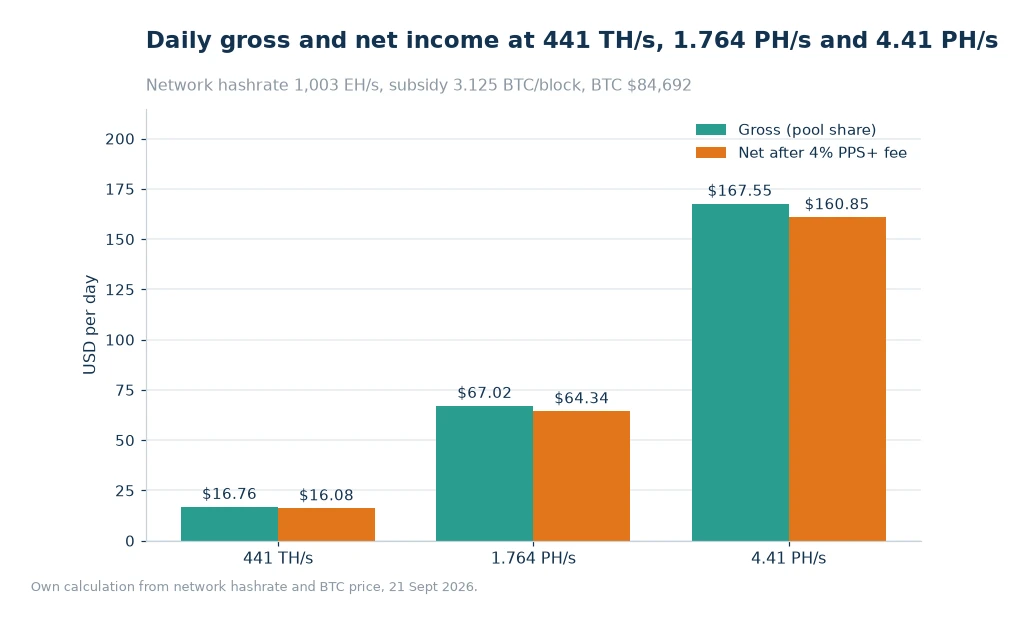
Comparing coins on a single screen is convenient and misleading in equal measure, because the tool does not switch algorithms for you. The BTC line at 441 TH/s reads 0.00019784 BTC a day, $16.76 gross and $16.08 after the listed 4% on the block-reward component; at 4.41 PH/s it reads $167.55 and $160.85. Every other coin needs its own inputs before it deserves a row.

Key takeaways
- 441 TH/s on BTC yields 0.00019784 BTC a day, or $16.08 net of the listed 4% on the block-reward component.
- Hashrate in TH/s means nothing across algorithms; compare coins on daily revenue and power draw instead.
- LTC and DOGE arrive through merged mining, so one machine can credit two chains at once.
- Run each candidate coin as its own row with its own difficulty, then compare the rows, never the rates.
Keys and algorithms are not interchangeable
A SHA-256 machine mines BTC and little else. A Scrypt machine mines LTC and, through merged mining, DOGE. Equipment built for KAS, ZEC, HNS, CKB or ETC follows its own rules, and a hashrate figure from one column cannot be dropped into another without a conversion that does not exist. The pool supports more than twenty coins; the hardware does not support more than one algorithm at a time.
That constraint is the first filter on any comparison. Before prices and difficulty enter the conversation, decide which machine you own or intend to own, then list only the coins that machine can hash. A comparison across algorithms is a comparison of two different businesses that happen to share a power socket.
What carries over between coins
Three things carry over: the settlement logic, the fee structure and the arithmetic. PPS+ settles the block-reward component hourly at a listed 4% and distributes the transaction-fee component at a listed 2%; PPLNS combines both at a listed 2% after six confirmations. Those rules apply across the pool's coins, which means one mental model covers every chain.
What does not carry over is the output. Each chain has its own difficulty, block subsidy and price, so the daily figure has to be rebuilt from scratch. The ViaBTC Mining Calculator handles the rebuild if you feed it the right coin, and the fee field is where a wrong default quietly distorts the answer. Treat the Profit Calculator as a per-coin instrument: one coin selected, one set of inputs, one row of output.
BTC and an alt path at the same power draw
The table keeps to BTC because the chart's numbers are BTC, but the columns are the ones an alt comparison needs as well. Replace the coin and every figure except the structure changes.
| Option | Hashrate | Daily coins | Value at $84,692 | After listed 4% |
|---|---|---|---|---|
| Single SHA-256 unit | 441 TH/s | 0.00019784 | $16.76 | $16.08 |
| Four-unit shelf | 1.764 PH/s | 0.00079136 | $67.02 | $64.34 |
| Ten-unit row | 4.41 PH/s | 0.00197835 | $167.55 | $160.85 |
Read it as a template rather than a verdict. The BTC row is the benchmark every alternative has to beat on the same power draw, and the power draw is the column the calculator does not fill in for you. An alt path that produces more dollars while pulling twice the current is not ahead; it is a different machine wearing the same rack space.
Merged mining changes the shape of the answer
LTC and DOGE are mined together, which means a Scrypt machine submitting work for one chain also earns credit on the other without extra electricity. That is the clearest case where a single-coin comparison understates the return, because the second stream is invisible if you only look at one row.
The discipline is to model merged output as one combined row, not two. Splitting it across two lines invites double-counting the power cost and makes the total look better than it is. Price the electricity once, then add both credits, then apply the fee to the combined result at the listed rate for the settlement mode chosen.
Reading a coin switch without hype
Coin switches get discussed as if difficulty and price stand still during the migration, and they never do. By the time a machine is reconfigured, repointed and tuned, the number that motivated the move has usually changed. That does not make switching irrational; it makes the timing matter more than the direction.
A useful habit is to state the switch in break-even terms. How many days at the new coin's current output does it take to recover the downtime and any conversion cost? If the answer is longer than the period you expect the advantage to last, the switch is a hobby rather than an optimisation, and there is nothing wrong with a hobby as long as it is labelled one.
Keeping one ledger for several chains
Multiple coins produce multiple wallets and multiple prices, which is how a profitable month gets lost in conversion. I convert everything to one reporting currency on the day it arrives and record the rate used. The multi-currency wallet keeps the balances in one place, and Auto Conversion removes the manual swap step for the coins I never intend to hold.
The ledger rule is simple: one row per coin per day, with the fiat value at the moment of credit. Do not restate yesterday's row when today's price moves. A restated ledger cannot answer the only question that matters at month end, which is what the machines actually produced.
Worked example
Build the BTC benchmark first, since every alt comparison gets measured against it.
- Gigahash: 441 TH/s = 441,000 GH/s.
- Network share: 441,000 ÷ 1,003,107,267,295 = 0.00000043964.
- Daily coins: 0.00000043964 × 450 = 0.00019784 BTC.
- Value: 0.00019784 × 84,692 = $16.76.
- Listed 4% line: 16.76 × 0.04 = $0.67.
- Net: 16.76 − 0.67 = $16.09, carried as $16.08 in the chart after rounding.
- Ten units at 4.41 PH/s: 0.00019784 × 10 = 0.0019784 BTC, $167.55 gross and $160.85 net.
Now the comparison step, which is where most people go wrong. Do not compare the alt coin's daily coin count with BTC's daily coin count. Compare the fiat value after the fee on the same power draw, and compare the conversion path: a coin with a thin market costs more to turn into currency than one with deep liquidity, and that spread belongs in the row.
Frequently asked questions
Can I point one machine at several coins at once?
Only where merged mining allows it, as with LTC and DOGE on the same Scrypt work; otherwise a machine mines one algorithm, and switching means stopping one chain before starting another.
Why does the same hashrate give different results on different coins?
Because difficulty, block subsidy and price are chain-specific. A TH/s is a unit of work per second, not a unit of income, so it has to be priced against each network separately.
Does the pool fee differ by coin?
The structure is the same across the pool: PPS+ charges a listed 4% on the block-reward component and a listed 2% on the transaction-fee component, while PPLNS charges a listed 2% on the combined total.
Shortlist two, then measure
Two candidates are enough for a first comparison. Build both rows with the same power assumption, the same fee mode and the same date, then pick the one whose downside still covers electricity. Keep the losing row in the file: in three months the ranking may reverse, and the old numbers are the only way to see whether the reversal was real or an artefact of a changed input. The published fee schedule supplies the one constant in that file, which is why it is worth checking before every re-run.
Sources: fee schedule, calculator and wallet pages on viabtc.com. Snapshot of 21 Sept 2026: 1,003 EH/s, 3.125 BTC subsidy per block, 144 blocks daily, BTC $84,692 and LTC $59.32[1]. Rows assume machines never pause. Published 24 Oct 2026.